About the Daily Office . . .

About the Daily Office . . .
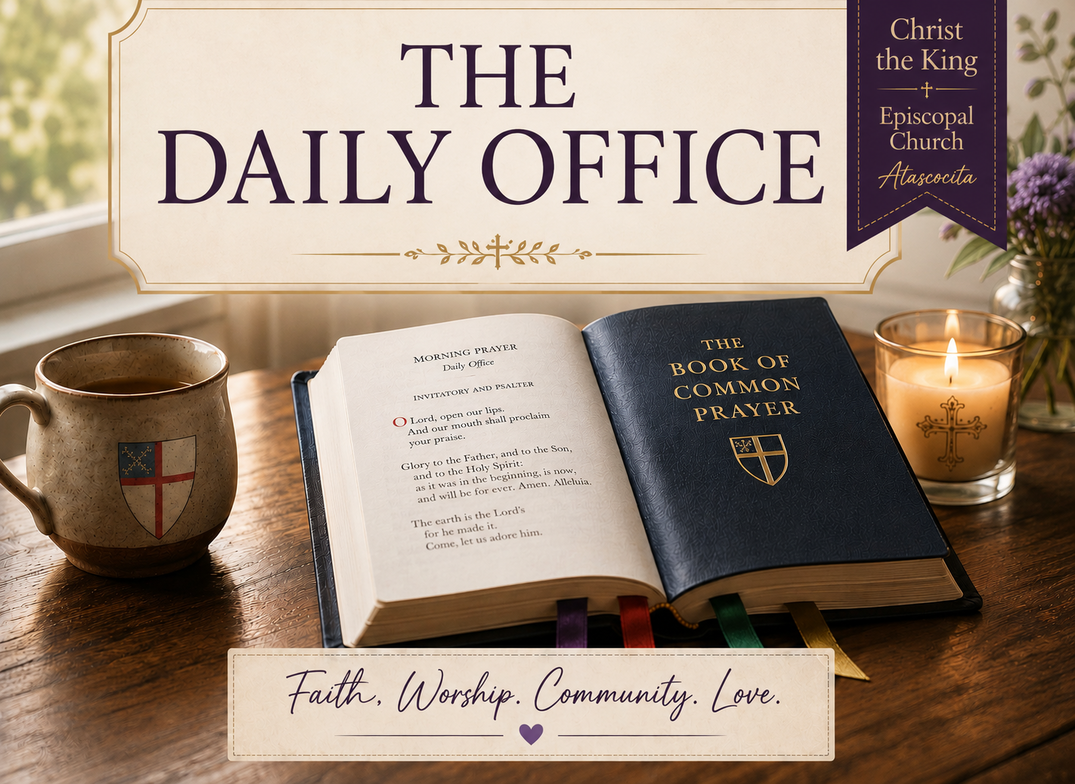
Here at Christ the King we gather for Morning Prayer every Thursday morning at 9:30. We also take the opportunity to use other services from the Daily Office, like Compline, whenever possible. These services connect us to long tradition of daily prayer.
Use of daily prayers to mark the times of the day and to express the traditions of the praying community is traditional in Judaism and in Christianity. The third, sixth, and nineth hours (9 A.M., 12 noon, and 3 P.M.) were times of private prayer in Judaism. The congregational or cathedral form of office developed in Christianity under Constantine (274 or 288-337) with the principal morning and evening services of lauds and vespers. The people participated in the cathedral form of office. The monastic form of office also developed at this time. In addition to lauds and vespers, the monastic form included matins (at midnight or cockcrow), prime (the first hour), terce (the third hour), sext (the sixth hour), none (the ninth hour), and compline (at bedtime). By the late Middle Ages, the Daily Office was seen as the responsibility of the monks and clergy rather than an occasion for participation by all in the prayers of the community throughout the day.
After the Anglican reformation, Archbishop Thomas Cranmer (1489-1556) reduced the eight monastic office to the two services of Morning and Evening Prayer. These services were printed in vernacular English and intended for use by all members of the church. Participation in the Daily Office is at the heart of Anglican spirituality. It is the proper form of daily public worship in the church. In addition to forms for Daily Morning Prayer and Daily evening Prayer, the Book of Common Prayer section for Daily Office includes forms for Noonday Prayer, Order of worship for Evening, Compline and Daily Devotions for Individuals and Families. These offices include prayers, a selection from the Psalter, reading from Holy Scriptures, one or more canticles, and the Lord’s Prayer. The officiant in the Daily Office may be a member of the clergy or a lay person.
Please come join us in this habit of corporate prayer.
May God bless you this week,
Mo. Catherine+